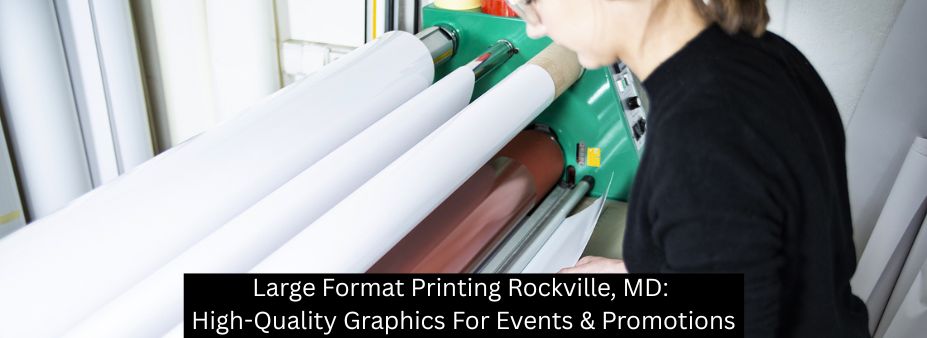
When a standard print will not fill the space, large format printing steps in. In Rockville, MD, businesses use large format graphics for event backdrops, promotional banners, wall murals, floor graphics, and trade show displays — applications where scale itself is part of the message. Rockville Sign Company produces large format printed graphics using commercial-grade wide-format equipment and a structured color calibration process that ensures what you see on screen closely reflects what comes off the press and into your hands.
Large format printing refers to any graphic produced on wide-format equipment — typically anything exceeding 24 inches in width. Wall murals and architectural wallcoverings, floor graphics for retail and event spaces, promotional banners hung indoors and outdoors, trade show backdrops, construction site graphics, and vehicle wraps all fall under this category.
The scale changes considerably across applications, but the same core production requirements — correct file resolution, accurate color management, and appropriate material selection — apply consistently across every large format project regardless of end use.
At standard print sizes, minor file quality issues are often invisible to the eye. At ten feet wide, those same issues become the first thing anyone notices. Low-resolution source files pixelate visibly. Incorrect color profiles produce output that does not match the brand colors in the original design. Poor substrate choices result in graphics that curl at the edges, fade within a season, or fail to adhere to the installation surface over time.
Files prepared for large format output should be built at the correct resolution for the intended viewing distance. Rockville Sign Company reviews all submitted files before production begins and flags resolution or color profile issues before a single inch of material is printed — not after the job is already running.
One of the most frequent complaints about large format graphics is color mismatch — the finished output does not match the original design file or the existing brand materials it needs to coordinate with. This happens when color management is skipped or treated as unimportant in the production workflow.
Rockville Sign Company uses a calibrated color management process to close the gap between what a brand asset displays on a monitor and what the physical printed output produces in a real environment. Businesses in Gaithersburg and Germantown exhibiting at trade shows or regional events frequently need multiple printed pieces — backdrops, table throws, retractable banners, and handouts — to look visually unified. If those pieces are not color-consistent with each other, the presentation reads as disorganized regardless of how good each individual piece looks on its own.
The substrate — the material the graphic is printed on — determines durability, how the graphic is installed, and how the finished piece looks and feels in person. Rockville Sign Company works with vinyl, fabric, foam board, coroplast, mesh banners, and specialty substrates depending on the specific application and environment.
Indoor event graphics and permanent wall installations use different materials than outdoor promotional banners or construction site wraps facing weather exposure. UV-resistant coatings, reinforced hemmed edges for banner grommets, and moisture-resistant substrates are standard specifications for any exterior application. Businesses in Potomac and Aspen Hill that need graphics for both indoor and outdoor use within the same event benefit from having one production team specify the right material for each piece — not a one-size-fits-all approach.
Large format projects with multiple pieces, custom substrates, or complex color requirements need adequate production and review time built into the schedule. Submitting files late or requesting rush production on large format jobs increases the risk of quality shortcuts that show up in the finished output.
Rockville Sign Company communicates production timelines clearly during the initial consultation so that every client — whether preparing for a trade show, a grand opening, or a seasonal promotion — has a realistic schedule that accounts for file review, proofing, production, and delivery.
KEY POINTS TABLE
| Factor | What to Know |
| File Resolution | Correct output resolution depends on graphic dimensions and the intended viewing distance |
| Color Calibration | Essential for matching new prints to existing brand materials and maintaining piece-to-piece consistency |
| Substrate Selection | Material choice depends entirely on indoor vs. outdoor environment and installation method |
| Viewing Distance | Longer intended viewing distances allow lower resolution without noticeable quality loss |
| Outdoor Durability | Exterior applications need UV-resistant inks, weatherproof substrates, and reinforced finishing |
| Production Lead Time | Complex large format projects require adequate scheduling — do not plan around last-minute delivery |
Head over to Rockville Sign Company’s trade show display services to see how large format printing is applied specifically to booth graphics, backdrops, and complete exhibit environments.
Take a look at Rockville Sign Company’s wall mural options to understand how large format printing transforms commercial interiors and office environments at full architectural scale.
Visit Rockville Sign Company’s color calibration page to understand the production process that ensures large format print output accurately matches your brand’s approved color standards.
Large format printing uses wide-format equipment to produce graphics that standard commercial printers cannot output — typically anything over 24 inches wide. It covers banners, vehicle wraps, wall murals, floor graphics, and event displays. The key production differences are scale, substrate variety, and the critical role of color management in achieving accurate output.
Vector files — AI, EPS, or PDF with embedded fonts and links — are ideal because they scale without any quality loss. High-resolution raster files at 300 DPI at the intended print size can also work. Rockville Sign Company reviews all submitted files before production begins and flags any resolution or color profile issues before printing starts.
The production team uses a structured color calibration process that accounts for the difference between how colors appear on a monitor and how they reproduce on physical substrates. This process also maintains consistency between multiple pieces produced at different times or printed on different materials — critical for trade show and event applications.
Large format graphics produced on outdoor-rated substrates with UV-resistant inks typically last 3 to 5 years in exterior applications. Temporary outdoor event graphics can be produced on lighter materials at lower cost for shorter intended lifespans without sacrificing the visual impact needed for the event itself.
Absolutely. Wall murals are one of the most impactful interior applications of large format printing. Rockville Sign Company produces custom wallpaper and wall graphic installations for offices, retail interiors, hospitality environments, and commercial spaces across Rockville and the surrounding Montgomery County region.
Large format printing in Rockville, MD is about far more than physical size — it is about accuracy, material performance, and visual impact when scale cannot be compromised. Whether you are producing event backdrops, a permanent wall mural, or a full suite of promotional graphics, the quality of the output is entirely dependent on the quality of the process behind it. Rockville Sign Company combines commercial-grade production equipment with structured color management to deliver large format results that match expectations from the first proof to the final installed graphic.
Back